*Originally published in Japanese in JMCA web+ on June 6th, 2025.
English translation by the author.
“Revisited Reality”—Rediscovering Brand Value Through the Five Senses
Walking through New York, you begin to notice an intriguing pattern. Fashion brands across entirely different price points and target audiences—Louis Vuitton, Uniqlo, Alexander Wang, and many local labels—are increasingly building cafés inside their stores.
Some may dismiss it as yet another wave of “brand restaurants.” But what’s happening now is fundamentally different from the restaurant-led brand theatrics of the 2000s and 2010s. This is a strategic phenomenon born of today’s post-pandemic consumer reality—where buying behavior has shifted dramatically, and physical retail is being redefined.
What Has Changed Is the “Purpose” Itself
The traditional brand restaurant functioned largely as a PR device: a way to stage luxury, sophistication, and a brand worldview. In many cases, it lived on a separate floor, under a separate operational framework, or as an entirely separate “box” from the store.
The cafés now appearing in New York operate differently. They are built inside the retail environment and function as a system designed with clear aims: lowering the threshold for store visits, maximizing dwell time, and deepening the brand experience.
From this installment onward, I’ll introduce several examples in sequence. If you have an opportunity to visit New York, these are well worth experiencing firsthand. You can enjoy them as food and drink, while also leaving with practical insights from a business perspective.
A Café Appears Inside Louis Vuitton—During Renovation
As one representative example, consider Le Café Louis Vuitton, created inside Louis Vuitton’s temporary store (LV hereafter).
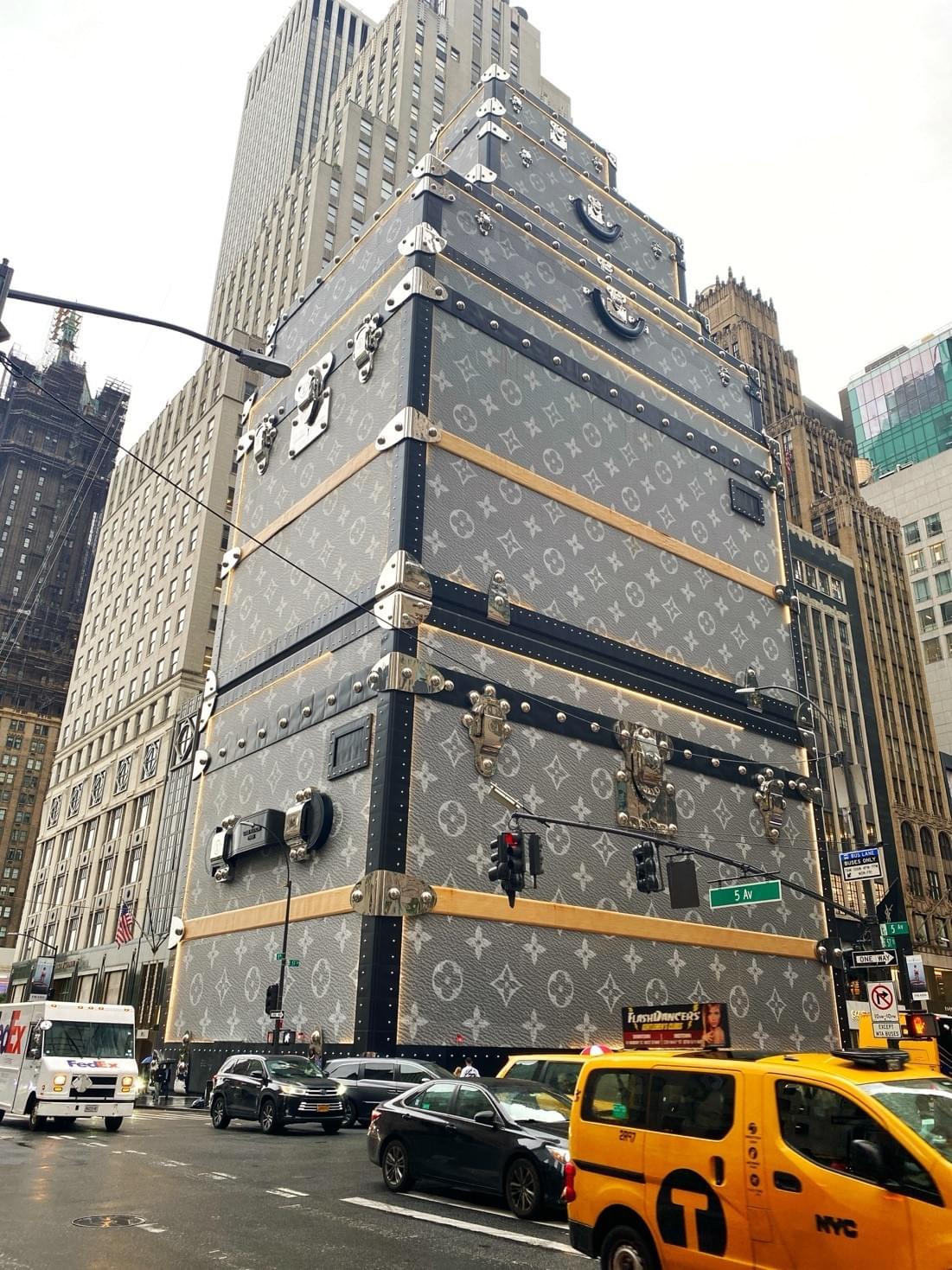
Photo: Niena Etsuko Hino
A tactic enabled precisely by renovation: maintaining LV’s presence at the corner of Fifth Avenue and 57th Street.
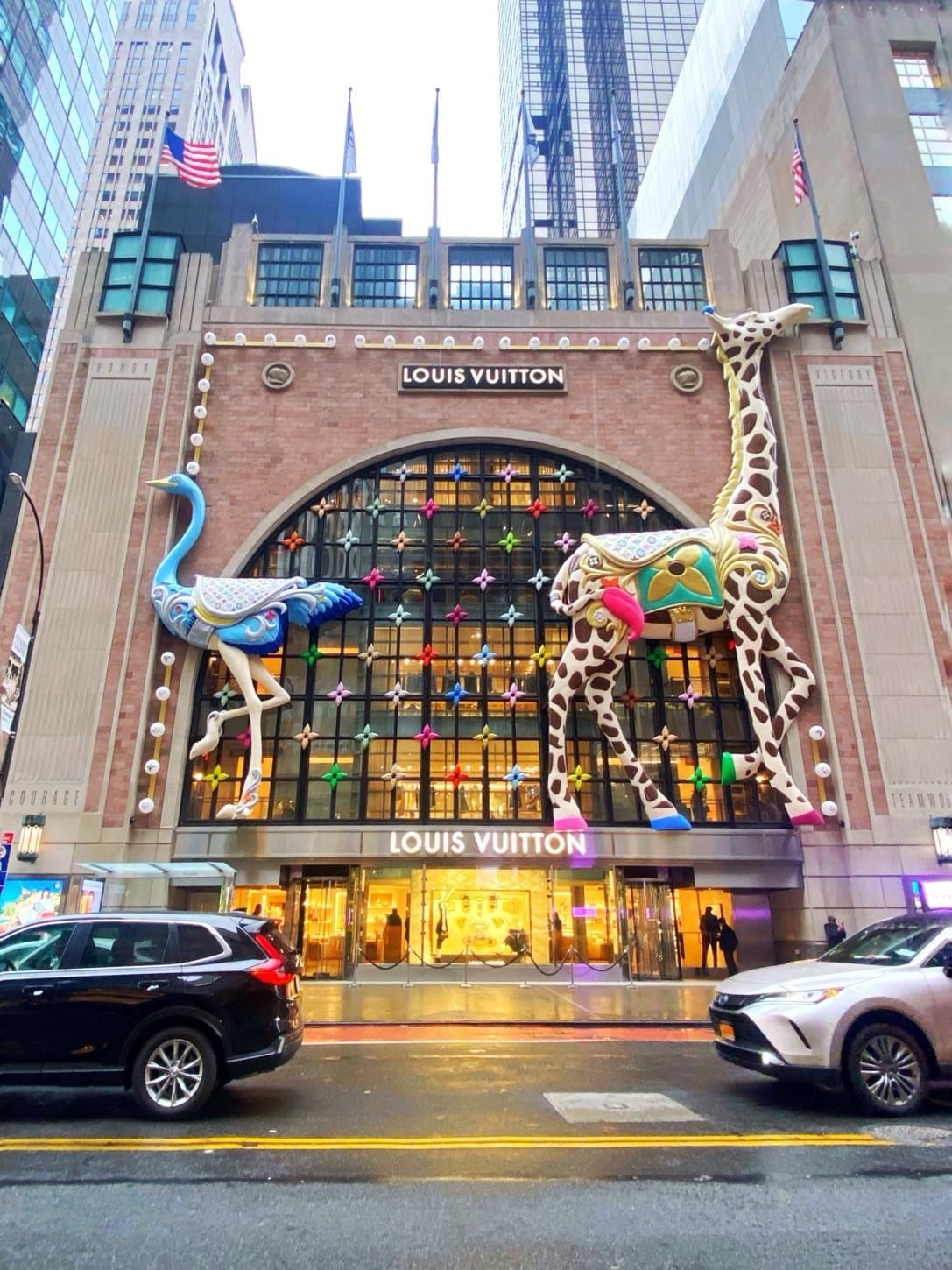
Photo: Niena Etsuko Hino
The Louis Vuitton temporary store.
This location was also used as Tiffany’s temporary store during its renewal, and long before that, it housed NikeTown.
On November 15, 2024, LV opened a vast temporary store at 6 East 57th Street as its Fifth Avenue flagship enters a multi-year renovation. On the fourth floor, Le Café Louis Vuitton was built as a café-and-library space filled with LV’s cultural inspirations—designed so visitors can settle in and immerse themselves in the atmosphere. The menu includes signature items such as truffle egg dishes and waffles served with caviar.
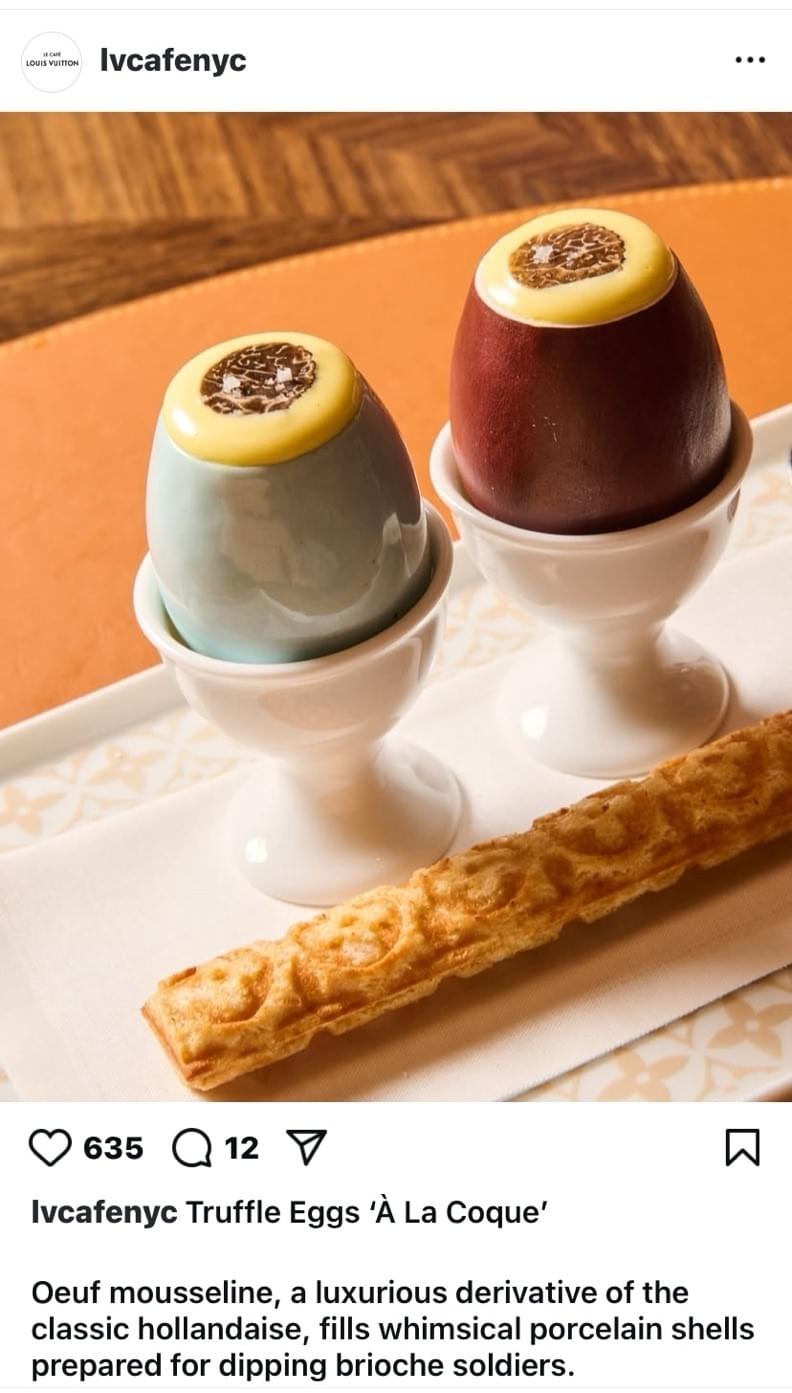
From Le Café Louis Vuitton’s Instagram
https://www.instagram.com/lvcafenyc
The Café Experience Is Designed to Function as a “Pre-Purchase” Stage
What matters here is that the café experience is set up with a clear understanding that it functions as a prelude to purchase.
In branded experiential spaces like these, longer dwell time tends to correlate with higher conversion. According to Harvard Business Review, there is a clear relationship between in-store engagement and purchasing behavior. McKinsey & Company likewise reports that companies prioritizing customer experience (CX) often see improvements in financial indicators such as revenue growth and repeat purchasing.
Sources:
Harvard Business Review, “A Study of 46,000 Shoppers Shows That Omnichannel Retailing Works”
https://hbr.org/2017/01/a-study-of-46000-shoppers-shows-that-omnichannel-retailing-works
McKinsey & Company, “Experience-led growth: A new way to create value.”
https://www.mckinsey.com/capabilities/growth-marketing-and-sales/our-insights/experience-led-growth-a-new-way-to-create-value
In fact, the author has never actively chosen to wear LV, and therefore never had a reason to go out of her way to visit an LV store. But once you hear there is a café, it becomes a plausible choice—somewhere you might try if you have the chance.
"Stopping for Tea” Creates a New Entry Point
The number of people who want to “take a break and have tea” is far greater than the number of people who go to a brand store specifically to shop. When you know there is a café, a simple thought appears: “Maybe I’ll stop by.”
A point of entry does not exist only because something is necessary. It also exists because something feels vaguely interesting.
Even those who never considered LV an option—or avoided it due to assumptions—can be nudged into visiting the store simply by thinking, “Maybe I’ll have tea there.” Once inside, the opportunity emerges to discover: “So this is what they offer.”
Why a Café, Not a Restaurant
With the earlier brand-restaurant model, the association was strongly “a full meal,” which often stretches the time horizon to “maybe someday.” A café, by contrast, allows for both a meal and “just tea,” making the usage threshold far lower and easier to try.
And because it’s a café inside an LV store, it also enables a form of natural filtering: who feels justified stepping into that environment in the first place. Pricing plays a role as well—quietly separating those who can enjoy it as a normal option from those who cannot. Rather than welcoming everyone indiscriminately, the space becomes a way to identify people who could realistically become future customers.
A Brand Space That Maintains Distance—Precisely Because of Where It Is
Midtown Manhattan, 57th Street, inside LV: this is not the kind of café you wander into casually because you happened to want coffee. That’s exactly why the flow of visitors becomes naturally selective, and why LV’s desired atmosphere and distance can be preserved.
Through the act of “having tea,” people are invited to touch the brand—just slightly. It becomes a structured moment of contact.
Within “Food,” Why Tea Matters
Among the three basic human desires, appetite is one of the strongest. Within that, “having tea” is uniquely tied to pausing and relaxing. If a brand can offer that kind of restorative moment inside its own worldview, it can reveal an appeal that may not have been visible before.
Niena’s Cut
Brand value is not conveyed by products alone. It is shaped by the spaces a brand creates, how people are invited to spend time there, and what they are able to feel through that time. The accumulation of those messages forms the foundation for trust and resonance.
Mechanisms built around “experience” and “dwell time,” like LV’s, can be applied far beyond fashion. Simply adopting the perspective of how to design a structure that makes someone think, “I might stop by,” can reveal new customer touchpoints—and new ways to build relationships.
This essay is part of Insights by Niena Etsuko Hino, a collection of selected English articles and translations exploring branding, executive presence, and cross-cultural business strategy.