*Originally published in Japanese in AdverTimes on May 22nd, 2026.
English translation by the author.
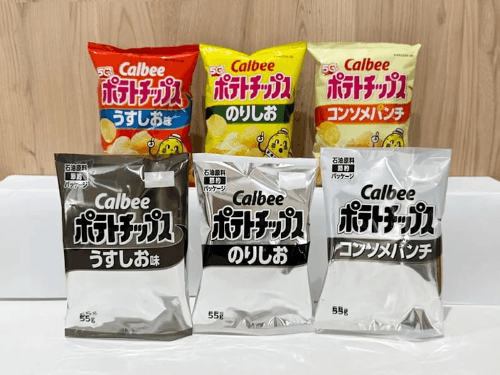
On May 12, 2026, Calbee announced that it would shift packaging for 14 of its flagship products — including its iconic potato chips — to two-color grayscale printing. In practical terms: black and white. The familiar full-color photography of golden chips would be gone. So would “Potato Boy,” the brand’s beloved mascot. Printing would be stripped to the bare minimum. The cause: an acute shortage of
naphtha, a key ingredient in printing ink, triggered by escalating tensions in the Middle East. The new packages were set to begin appearing on store shelves the week of May 25.
Two days later, on the 14th, Kagome followed. The company announced a redesign of its Tomato Ketchup packaging — in 500g, 300g, and 180g sizes — in which the transparent portion of the outer bag would expand to cover roughly three-quarters of the surface. The culprit here: white ink. Kagome’s packaging uses white ink as a printing base on transparent film, and with supplies
depleted, the company had no choice but to retire the tomato-pattern design it had used for more than 40 years. What had once been a bag bursting with tomato imagery would now show the pattern on just one-quarter of the surface.
Calbee goes black and white. Kagome goes transparent. The mechanics differ, but the underlying reality is the same: color is disappearing.
Writing from New York, I won’t be seeing those shelves anytime soon. Monochrome potato chip
bags printed over silver reflective film, ketchup pouches dominated by empty space — that’s a Japanese story for now, and it will be some time before the ripple reaches Japanese grocery stores overseas. More to the point, consumers haven’t yet encountered the actual products. The announcements have been made; the reactions are still to come.
“Packaging is the product’s face.” “Color is its soul.”
In branding, there is a concept known as “ownership color” — the state in which a specific hue has become so deeply embedded in consumer memory that it instantly summons a particular brand. In U.S. trademark law, this is formalized as “secondary meaning.” A landmark 1995 Supreme Court ruling in Qualitex Co. v. Jacobson Products established that, under certain conditions, color alone can be
trademarked.
Tiffany’srobin’s egg blue. UPS’s brown. T-Mobile’s magenta. These are not just design choices — they are registered trademarks. Competitors cannot use them. That is the power color holds: the ability to conjure an entire brand in an instant.
In terms of raw neural speed, hearing actually beats sight. That’s presumably why emergency alarms are acoustic, not visual. But when it comes to transmitting brand meaning — instantly, without language — vision reigns, and color is its most potent weapon. Consider: when you spot a Starbucks sign from across the street, you don’t first read the word or trace the mermaid’s silhouette. You register that deep forest green, and you know. The same mechanism operates at the
supermarket shelf. A consumer’s hand reaches out in a fraction of a second, and color is the trigger. That is why color is the soul of a brand.
Food packaging is no exception. The red in Calbee’s logo. The magenta pink of the words “Potato Chips.” The orange of the lightly salted variety. The pale yellow of Consomme Punch, evoking the flavor itself. Potato Boy’s cream complexion and his diagonal red-and-white sash. Kagome’s rich red that instantly conjures tomatoes, set against a white background that makes it pop. These are not
arbitrary choices. They are precisely calibrated palettes designed to position everyday food products, make them look delicious, feel familiar, and generate an almost reflexive purchase impulse. Premium or avant-garde products can afford stark black-and-white packaging — the severity suits them. But for
affordable, everyday staples, warmth, appetite appeal, and color-coded familiarity are not optional. They are essential. These are products that belong at the opposite end of the spectrum from monochrome.
And crucially: these colors are assets. They have been accumulated over decades and imprinted
on consumer memory. They drive shelf visibility. They trigger purchase behavior. They make brands legible and trustworthy at a glance.
The decision to strip away that asset was not made lightly. Both companies made it anyway.
The international press took notice. CNN reported on the day of the announcement, noting that shoppers would now have to rely on the text on the bag — rather than color — to identify their preferred flavor. NPR described the new packaging as a “somber black-and-white design” and specifically highlighted the absence of Calbee’s mascot. Creative Bloq, a design-focused outlet, framed the situation in terms of what designers call the “silhouette test” or “monochrome
test” — the principle that a brand should remain recognizable even stripped of color. The Calbee situation, the outlet argued, would put that principle to a real-world test.
Calbee’s press release stated that the change was made “from the perspective of prioritizing
stable product supply.” Kagome offered a similar rationale, expressing regret over changing a design that customers had loved for so long, but framing it as an unavoidable measure to keep the product on shelves. Both companies, in essence, chose presence over appearance. They prioritized the long-term consumer touchpoint — a product that exists on the shelf — over short-term brand aesthetics.
“Supply Chain Branding”: A New Strategic Question
This episode raises a question that brand strategists will increasingly need to grapple with: when supply chain disruption forces a change to the product’s face, how does a brand decide what to protect, what to sacrifice, and what to communicate?
The choices Calbee and Kagome made represent one model. Rather than raising prices, both companies opted for packaging simplification — an honest response to a physical constraint (“the raw materials simply aren’t available”) rather than a financial calculation. And Calbee went further: it printed the words “Petroleum-Saving Package” in the upper left corner of every bag. The explanation was built into the product itself.
The harder test lies ahead. Consumers who saw the announcement will respond very differently from those who didn’t. Press releases were issued. The news went wide. Social media picked it up. But a significant portion of the population remains outside that information flow — and for a product that spans age groups from small children to the elderly, many consumers will encounter the new packaging cold, standing in front of a shelf with no prior context. Will they notice the explanatory text? Will they read it? The real measure of these companies’ consumer communication strategies will be taken once the products are actually in stores.
For marketing and communications professionals, this is the live case study: when external forces compel a change to your brand’s face, what is your framework for decision-making? What do you protect? What do you let go? What do you owe your consumers in terms of explanation? Calbee and Kagome have offered one answer. Whether it was the right one remains to be seen.
An Ending Worth Hoping For
Following this story, I found myself thinking of The Little Mermaid — the original Andersen version, not the Disney one. The mermaid surrenders her voice. She endures searing pain with every step. She never wins the prince’s love. She dissolves into sea foam.
Calbee and Kagome have, in their way, surrendered their voice — the brand colors they spent years building — in order to keep delivering. The phrase “we are deeply sorry for this change” in Kagome’s statement carries more weight than it may appear. That single line holds the pain of the decision.
But if we’re allowed to hope, let the ending be the Disney version.
In that story, Ariel gets her voice back. She gets her legs. She gets the prince. The sacrifice is not permanent.
When the geopolitical tensions ease, and ink supplies stabilize — when Calbee’s orange and yellow and Potato Boy return to the shelves, when Kagome’s tomato-covered bags are back in full — I’ll be watching for it. And I hope that someday, picking up one of those familiar, colorful bags at a Japanese grocery store in New York, I’ll be able to say: “Remember when?”
This article is part of Insights by Niena Etsuko Hino, a collection of selected English articles and translations exploring branding, executive presence, and cross-cultural business strategy.